
Moving Out of California? How to Sell Your Orange County Home

How do you sell your Orange County home when you're moving out of state?
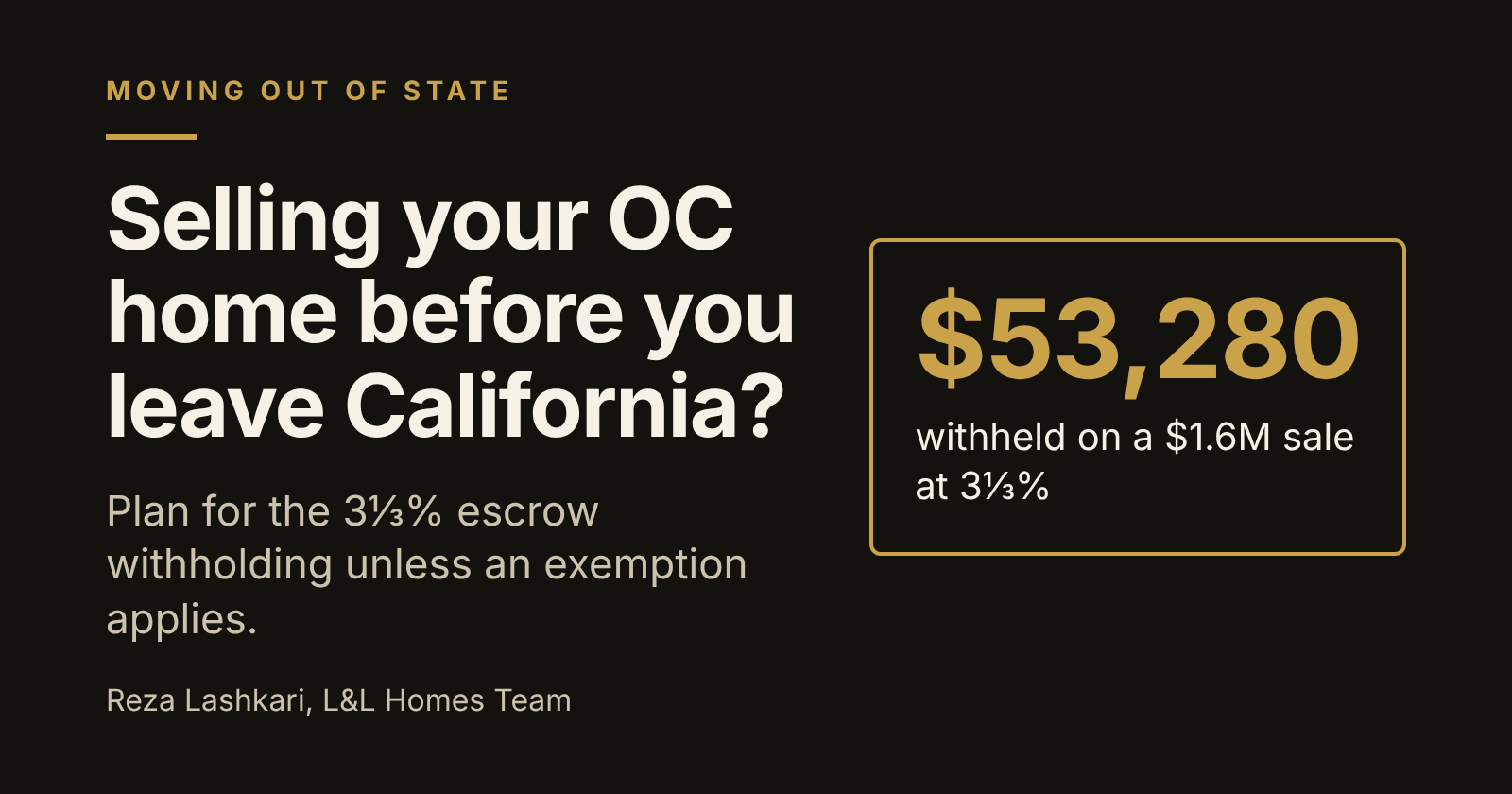
Decide first whether you'll sell before you move or after, because that choice drives your taxes, your timeline, and your stress level. Most out-of-state movers do best listing while the home is still furnished and they can still be reached locally, then closing with a short rent-back or a firm move date. Also know that California escrow may withhold 3⅓% of your sale price for the Franchise Tax Board unless you qualify for an exemption such as the principal-residence exemption.
By Reza Lashkari | September 28, 2026 | 6 Minute Read
Relocating out of state is one of the most common questions I get from Mission Viejo and South County homeowners right now. Some are chasing a lower cost of living, some are moving closer to family, and some have a job change with a start date that isn't moving. The house has to fit around that date.
Sell before you move, or after?
Selling before you move
- Pros: You're here for showings, repairs, the appraisal, and any buyer requests. The home usually shows better lived-in but staged. You know your net before you buy in the new state.
- Cons: You may need a short-term rental or a rent-back after closing. You might carry two housing costs for a month or two.
Selling after you move
- Pros: You can move on your schedule, and the house can be professionally cleaned and staged empty.
- Cons: You're paying the mortgage, taxes, insurance, HOA dues, and utilities on an empty home. Every repair or inspection issue gets handled remotely. Vacant homes can also be harder to insure for long periods — ask your carrier.
Timing matters more than usual right now. OC Real Estate Inc.'s September 28 report shows a 46-day median market time countywide, with the $1 million to $2 million range moving fastest at about 40 days and homes above $2 million at about 59 days. Add 30 days or so for escrow, and you're looking at roughly two to three months from list to close.
The California withholding most sellers don't expect
When you sell California real estate, escrow is generally required to withhold part of your proceeds and send it to the Franchise Tax Board, using Form 593. According to the FTB's 2026 instructions:
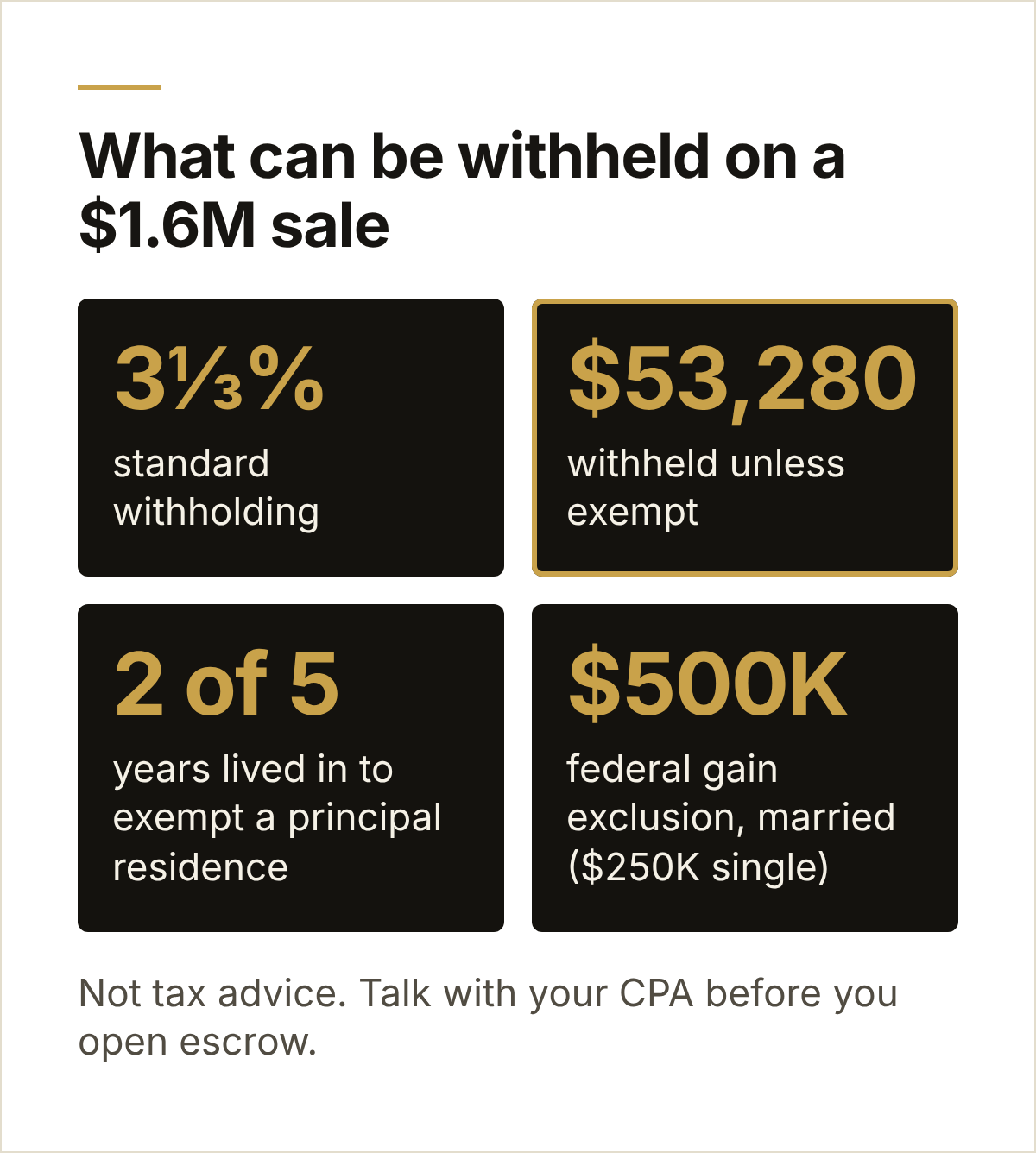
- The standard withholding is 3⅓% of the sales price.
- Instead, you can elect to withhold based on your estimated gain at your tax rate.
- Common exemptions include selling your principal residence (you owned and lived in it for at least two of the last five years), a sale price of $100,000 or less, or a sale that results in a loss or zero gain for California tax purposes.
Withholding isn't the final tax bill. It's a prepayment. If too much was withheld, you claim it back when you file your California return.
Here's why it matters for planning. On a $1,600,000 sale, 3⅓% is about $53,280. If you're counting on that cash for a down payment in Texas, Arizona, Nevada, Idaho, or wherever you're headed, you want to know in advance whether an exemption applies. Your escrow officer will send the Form 593 paperwork, but talk with your CPA before you open escrow.
Taxes still follow the house after you leave
A CPA who works with California nonresidents makes a point I repeat to clients: the gain on California real estate is California-source income, even after you move. Moving out doesn't erase California's claim on the sale.
The federal home sale exclusion still works the same way:
- Up to $250,000 of gain excluded if you're single, or $500,000 if you're married filing jointly
- You must have owned and lived in the home at least two of the last five years
- That means you generally have up to three years after moving out to sell and still meet the test
Long-time Orange County owners can have gains well above those limits. If that's you, your cost basis what you paid plus qualifying improvements matters a lot. Pull your closing statement from the original purchase and records of major improvements now, before you pack the files.
If you rent the home out after moving, the math changes. Depreciation taken while it's a rental can't be excluded, and being a long-distance landlord is its own job. I cover the rent-or-sell trade-off in our post on whether to sell first or buy first when rates are over 7%.
For the full picture, here is what it costs to sell a home in Orange County in 2026.
A timeline that works
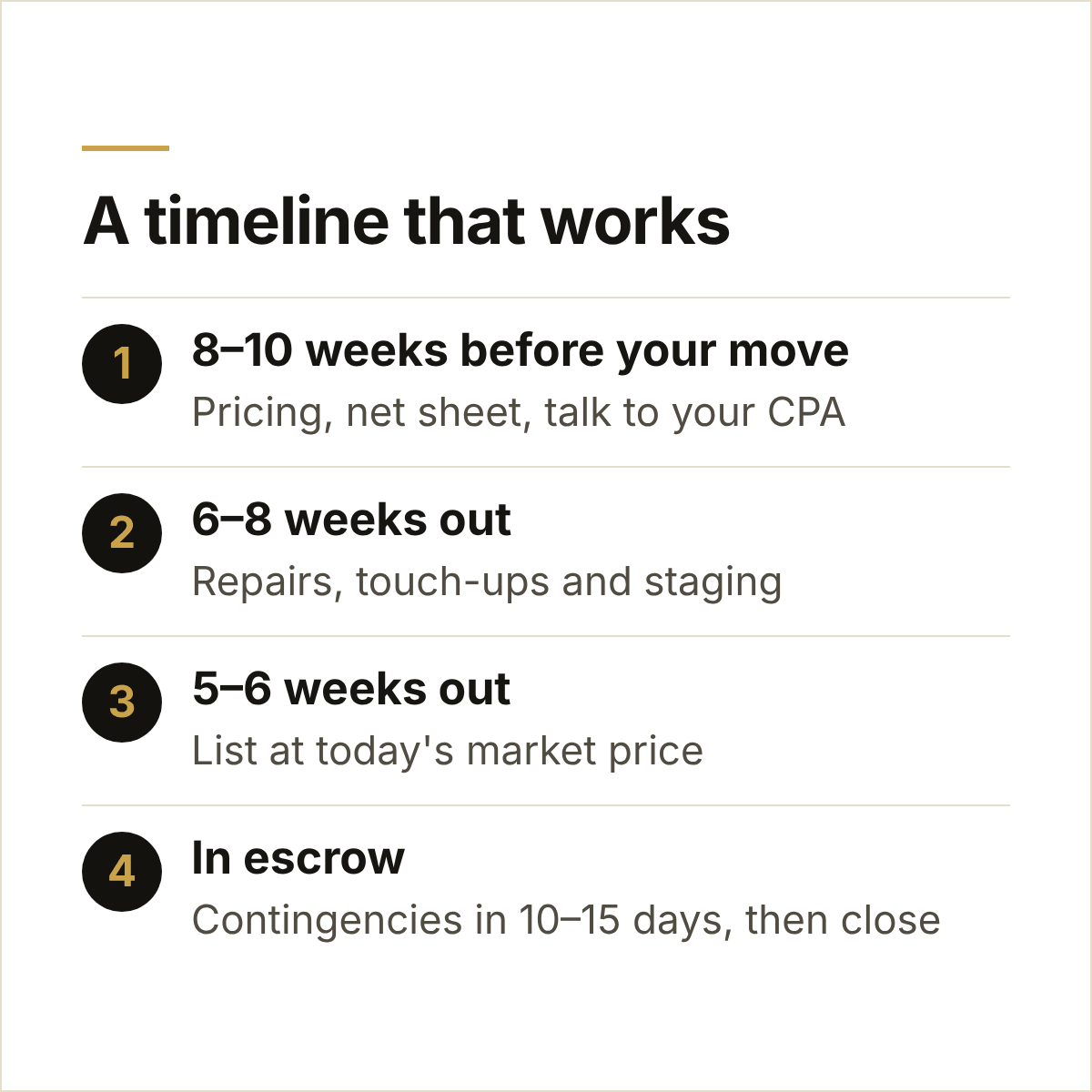
- 8–10 weeks before your move: Get a pricing analysis and a net sheet. Talk to your CPA about withholding and gain.
- 6–8 weeks out: Handle repairs, touch-ups, and staging. Order a pre-listing inspection if the home is older.
- 5–6 weeks out: List. Price for the market you're in, not the one from 2022 about 43% of Orange County listings have had a price reduction, according to the same weekly report.
- In escrow: Remove contingencies on schedule. In our market, that's often within 10 to 15 days.
- Closing: Negotiate a move-out date or a short rent-back. Your buyer's lender will generally allow a seller rent-back of up to 60 days, though many jumbo lenders cap it at 30.
Selling from another state
If you've already moved, you can still sell smoothly. You'll sign most documents electronically, use a mobile notary for the grant deed, and rely on your agent to coordinate inspectors, the appraiser, and any vendors. Leave keys with your agent, keep utilities on, and make sure your insurance covers a vacant home.
Selling from a distance? A pre-listing inspection can surface repair issues before a buyer does, so there are fewer surprises once you are gone.
Buying in the new state before you sell here?
This is where people get stuck. You find the house in the new city, but your equity is still tied up in Orange County. A sale contingency makes your offer weaker, and borrowing against your home adds cost and risk. That's the exact problem our Door to Door Program was built for it's a cash-offer program, not a loan, and eligibility and terms depend on your situation.
If you need to buy before you sell, compare a bridge loan, HELOC, or cash-offer program.
Frequently Asked Questions
Does California withhold taxes when I sell my house?
Often, yes. Escrow generally withholds 3⅓% of the sales price for the Franchise Tax Board unless an exemption applies, such as selling your principal residence that meets the two-of-five-year test. It's a prepayment, not the final tax bill.
Do I still pay California tax if I sell after moving out of state?
Generally yes on any taxable gain, because gain from California real estate is California-source income. The federal home sale exclusion can still apply if you meet the ownership and use test.
How long can I wait to sell after moving out and still get the $250,000/$500,000 exclusion?
You need to have owned and lived in the home at least two of the five years before the sale, which usually gives you up to three years after moving out. Confirm your dates with a tax professional.
Is it better to sell before or after moving out of California?
For most sellers, listing before the move is easier because you can handle showings and repairs in person. Selling after works if you can carry the costs of a vacant home and handle things remotely.
How long does it take to sell a home in Orange County right now?
The median home is taking about 46 days to go under contract, according to OC Real Estate Inc.'s September 28 report, plus roughly 30 days of escrow.
Ready to Plan Your Move?
Moving out of state is a timeline problem as much as a pricing problem. Worried about juggling the sale of your current home with buying your next one? Our Door to Door Program lets you make your offer as a true cash buyer no contingent offer, no traditional bridge loan so you can move on your timeline. Learn more about the Door to Door Program, or reach out and I'll build a sale timeline around your move date.

About Reza Lashkari
Reza Lashkari is the Team Leader of L&L Homes Team at Real Broker, with 13+ years of experience helping buyers and sellers across Orange County. A Mission Viejo resident and longtime local youth sports coach, Reza guides families through every step of buying, selling, and relocating, whether they are moving up, downsizing, or moving across the country.CA DRE #02195314 | Broker DRE #02022092 | 949-826-8100 | reza@llhomesteam.com
This article is for general information only and is not legal, tax, or financial advice. Rates, fees, and eligibility for loans and programs change frequently and vary by lender. The figures above are published estimates and illustrations, not quotes. Consult your lender and tax professional about your situation. Reza Lashkari, CA DRE #02195314, L&L Homes Team at Real Broker (Broker DRE #02022092). Equal Housing Opportunity.
Categories
Recent Posts









Realtor License ID: 02195314, 9527841, RES.0044054
+1(949) 826-8100 | reza@llhomesteam.com