
What Is the Supplemental Tax Bill When You Buy a Home in Orange County?

What Is the Supplemental Tax Bill When You Buy a Home in Orange County?

Reza Lashkari | October 4, 2026 | 6 Minute Read
Short answer: When you buy a home in Orange County, the county reassesses it at your purchase price and sends you a supplemental tax bill for the difference between the old assessed value and the new one, prorated from the month after closing through the end of the fiscal year on June 30. On a $1.5 million purchase where the seller's assessed value was much lower, that bill can run into the thousands of dollars. It usually arrives months after closing and is typically not covered by your mortgage impound account, so you need to plan for it in cash.
Why Do Buyers Get a Second Property Tax Bill?
California's Proposition 13 keeps a property's taxable value low for as long as the same owner holds it. When ownership changes, the home is reassessed to its new market value, which in most sales is your purchase price. The county's regular tax bill for the current year still reflects the old owner's lower value. The supplemental bill covers the gap.
The Orange County Treasurer-Tax Collector explains it this way: supplemental taxes are levied on the property as it exists on the date of the change in ownership. If the new assessed value is higher than the old one, you receive a supplemental bill. If it were lower, you would get a refund.
That means you can pay a regular bill based on the previous value and a supplemental bill for the increase in the same fiscal year. Most buyers don't see this coming, because the closing costs on your loan estimate don't include it.
How Much Will It Cost?
Here is an illustration, not a tax bill. Assume you buy a home for $1,500,000 and the seller's assessed value was $700,000, which is a plausible number for a home someone has owned for a long time. The increase is $800,000.
Base property tax is 1% of assessed value, and most established Orange County areas carry voter-approved bonds and other charges that push the effective rate to roughly 1.1% to 1.3%, according to one local property tax explainer. Homes in Mello-Roos districts, which are common in newer master-planned areas, can run higher. Using 1.2% as a round number:
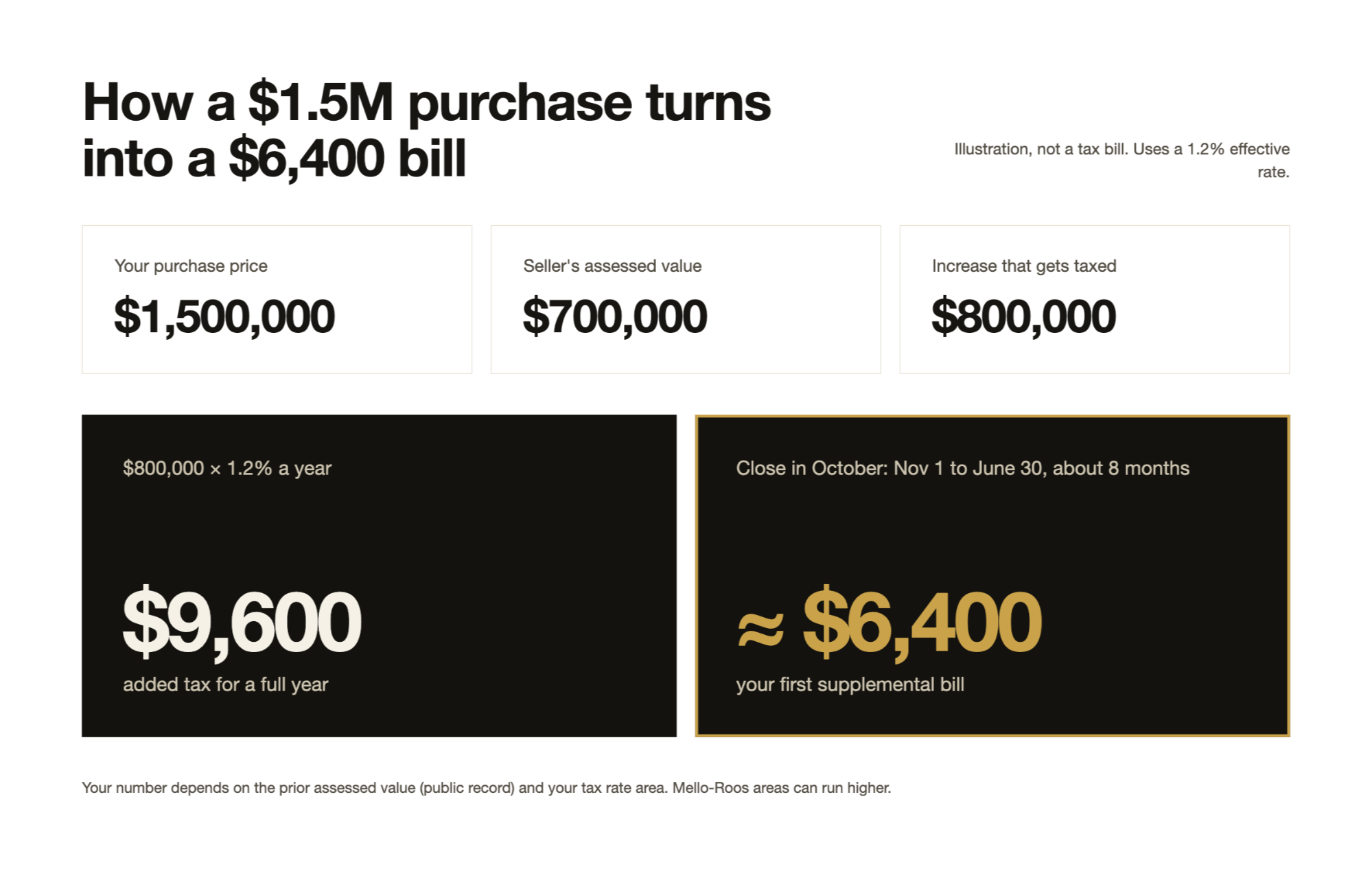
- Annual tax on the increase: $800,000 x 1.2% = about $9,600 a year
- If you close in October: the supplemental takes effect the first of the following month, so it covers about 8 months, or roughly $6,400
- If you close in February: you may receive two supplemental assessments, one for the remainder of the current fiscal year, about 4 months or roughly $3,200, and another for the following year
The same local explainer suggests budgeting about $6,000 to $10,000 for supplemental bills on a $1.5 million purchase, depending on how long the prior owner held the home and where it is. Your actual number depends on the prior assessed value, which is public record, and on your tax rate area.
When Do You Pay It, and Who Collects?
According to the Orange County Assessor, when a change of ownership occurs on or after June 1 but before January 1, one supplemental assessment is issued. When it occurs between January 1 and May 31, two are issued. The Treasurer-Tax Collector mails the bills a few times a year, and payment is due in two installments, with due dates that depend on when the bill is mailed.
Here is the part that catches people. Supplemental bills are typically not included in your mortgage impound account, which means your lender won't pay them for you. If you don't pay on time, penalties apply. Put the bill on your calendar as soon as you get it.
 What Should You Do When It Arrives?
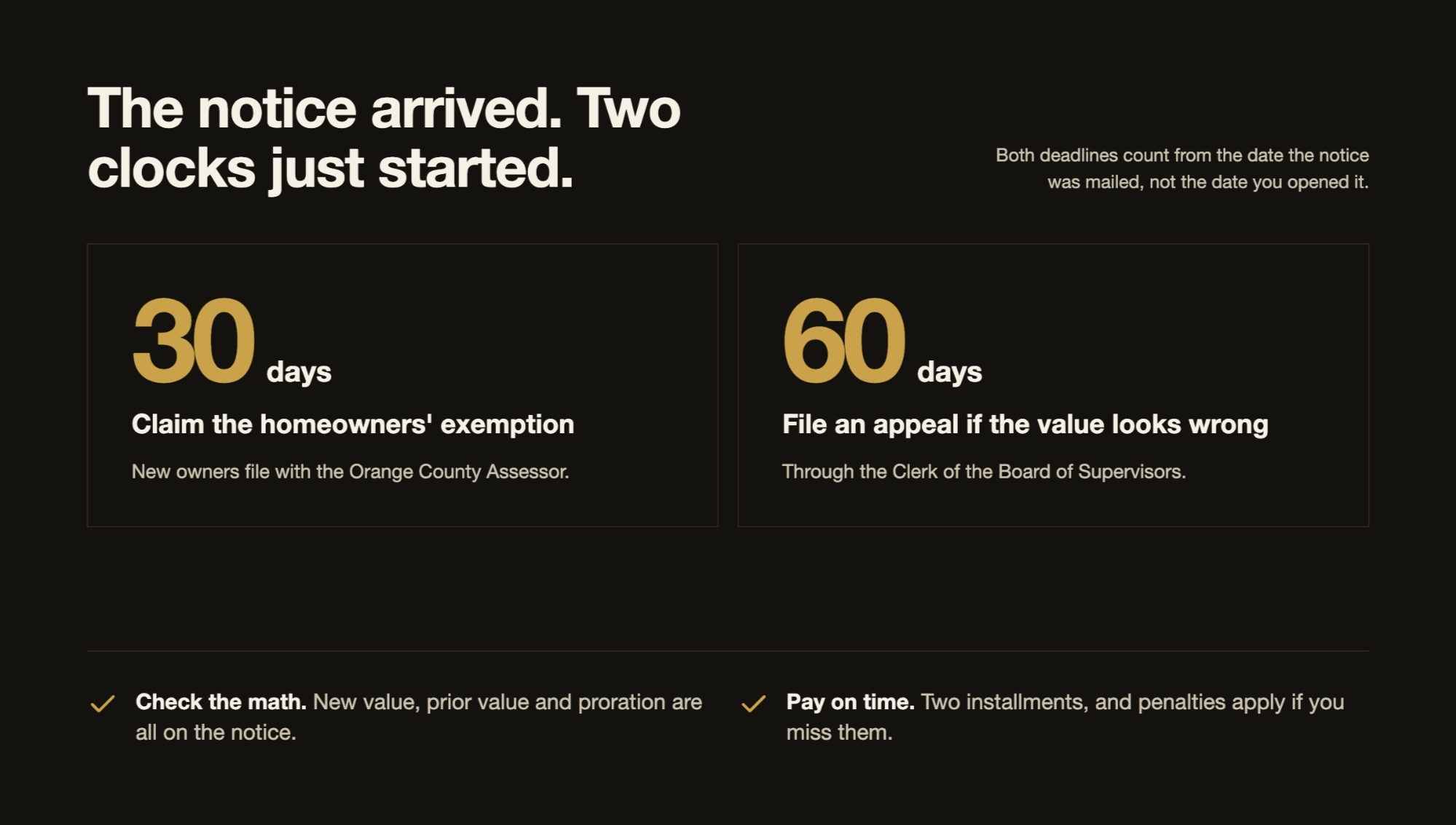
- Check the math. The notice shows the new assessed value, the prior value, and the proration.
- Claim the homeowners' exemption. New owners have 30 days from the date the notice is mailed to claim it, according to the Assessor.
- Know the appeal window. You can file an assessment appeal within 60 days of the notice mailing date if you believe the value is wrong. Contact the Clerk of the Board of Supervisors.
- Set the money aside now. Treat it as part of your closing cash, not as a surprise.
Does This Change What Your Regular Payment Will Be?
Yes. After the reassessment, your regular annual tax bill will be based on the new value. On a $1,500,000 purchase at a 1.2% rate, that's roughly $18,000 a year, or about $1,500 a month, before any Mello-Roos assessments or HOA dues. That is why I ask buyers to look at the full monthly cost of a home, not just the mortgage payment. With rates over 7%, principal and interest is only part of the picture.
If you're a buyer stretching to reach a payment, ask your lender to include a realistic tax estimate based on your purchase price and the area's tax rate, not the seller's current bill. Sellers' tax bills are usually much lower and can make a home look cheaper than it will be for you.
Buyers who are 55 or older and moving within California may qualify to carry their existing tax base to a replacement home under Proposition 19. That is a separate topic, and I'll cover it in an upcoming post.
If you're also selling, see our post on whether to sell first or buy first when rates are over 7%.
Frequently Asked Questions
What is a supplemental property tax bill in California?
It's an additional bill that reflects the increase in a property's assessed value after a change of ownership or new construction. It's prorated from the effective date through the end of the fiscal year, June 30.
When will I receive my supplemental tax bill after buying a home?
Timing varies. Bills are mailed a few times a year, and some buyers don't see theirs for several months after closing. One local explainer says to expect it within about 6 to 18 months, so plan ahead rather than waiting for the notice.
Is the supplemental tax bill included in my impound account?
Usually not. The Orange County Treasurer-Tax Collector notes that supplemental taxes are typically not covered by mortgage impound accounts, so you pay them directly.
Can I get more than one supplemental bill?
Yes. In Orange County, a change of ownership between January 1 and May 31 typically produces two supplemental assessments, and a change between June 1 and December 31 produces one.
Can I appeal a supplemental assessment?
Yes. You can file an assessment appeal within 60 days of the notice mailing date.
Ready to Plan the Full Cost of Your Move?
Buying a home without a home to sell? Our Dream Program gives you the strength of a cash buyer so your offer stands out. Learn more about the Dream Program, or use the contact form on this page and I'll walk you through the full monthly cost of a home you're considering, taxes included.
 About Reza Lashkari
Reza Lashkari is the Team Leader of L&L Homes Team at Real Broker, with 13+ years of experience helping buyers and sellers across Orange County. A Mission Viejo resident and longtime local youth sports coach, Reza guides families through every step of buying, selling, and relocating, whether they are moving up, downsizing, or moving across the country.CA DRE #02195314 | Broker DRE #02022092 | 949-826-8100 | reza@llhomesteam.com
This article is for general information only and is not legal, tax, or financial advice. Rates, fees, and eligibility for loans and programs change frequently and vary by lender. The figures above are published estimates and illustrations, not quotes. Consult your lender and tax professional about your situation. Reza Lashkari, CA DRE #02195314, L&L Homes Team at Real Broker (Broker DRE #02022092). Equal Housing Opportunity.
Tags: Buying, Orange County, Property Taxes, Closing Costs
Categories
Recent Posts









Realtor License ID: 02195314, 9527841, RES.0044054
+1(949) 826-8100 | reza@llhomesteam.com